Outsourcing - Be Very Cautious
Posted by Kevin Brady on Tue 1st August 2006 at 06:18 PM, Filed in
Unless you do something very special, developing large scale IT systems is not, as they say in the stock market, “an investment suitable for wives or widows”.
Sad but true !

Given the failure rates and high costs of large scale IT projects I struggle to comprehend the following:-
• Why is national IT expenditure increasing year on year?
• Why has the UK Government increased its IT expenditure almost logarithmically over the past 10 years?
Let’s look at the figures so you can see for yourself just how crazy this situation has become from a straight money perspective:-
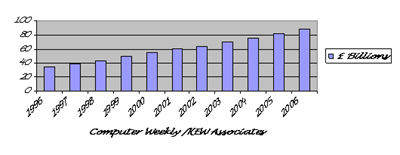
UK IT Spending
I grant you that some of the above expenditure increases is related to maintenance and support of existing systems, and some to the purchase of replacement hardware /package software, none of which can be attributed to the cost of IT failures. Many surveys carried out in the UK and the US indicates that half of this IT spending is attributable to the running of IT related projects. Therefore, this leaves UK PLC with the following dead-weight IT financial losses, depending on your chosen definition of failure:-
40% of £44.05 billion = £17.62 billion (canned projects)
70% of £44.05 billion = £30.84 billion (political deliveries)
I therefore propose that government and non-government organisations need outsourcing, insourcing, partnering, off-shoring like a hole-in-the-head. This whole farce is akin to admitting defeat, and sweeping the dirt under someone else’s carpet and paying the owner of the carpet to keep the dirt out of your front room. The carpet owner is often prepared, as a short to medium term sweetener, to offer reductions in running cost, for minding this dirt. The carpet owners without fail also claim that they have expertise and magical powers that would mean the dirt handling will be less of a problem going forward under their stewardship.
CTO’s /IT Directors love this kind of big hitting, instant, win-win situation involving little hands-on risk to themselves.
Furthermore, if the outsourcer is one of the BIG 5 Management Consultants “Money Machines” then the old saying “no-one ever got the sack for failed projects run by IBM” still applies.
It’s a no brainier situation for a CTO /CIO /IT Director from a personal career perspective. With staff turnover rates at this level running at 30% per annum this is a great medium term survival strategy !!
However, the lure of better delivery at reduced costs can all be short lived looking at the growing band of large corporates (Prudential Insurance, Sainsbury’s) who are taking their IT operations back in-house. Going forward commitments to real cost reduction by outsourcers are often ignored or disintermediated, leading to rising IT costs. More pain often follows :-
- Project failures can be worse than ever because outsourcers very often don’t have a strong enough interest in the host organisations future success. Project failures are nearly always expensive and, as in the Gold Rush, the shovel sellers always come out on top because their success never depended on their clients finding Gold, they won either way. Don’t ever forget outsourcers are fee earning profit centres, stuck right in the middle of your business. Believe you me fees are all that matters to these guys!
- Operational running costs can increase due to errors in strategic IT approach . Very often organisations at the best of times have to contend with growing numbers of legacy systems without migration paths and system enhancement programmes with serious maintainability issues through inadequate documentation. The host organisations business people are often behind the forging of these strategic IT mistakes because of their desire for cheap, quick-to-deliver systems. Outsourcers love this kind situation as mistakes like this earn more fees and help outsourcers break out of fee capped outsourcing agreements. It ‘s not in their interests to break their necks to change a host companies corporate culture when they win so heavily from the disasters.
- CTOs /IT directors and CEO’s can’t deal with the problems easily because the outsourcers are a separate company, and managerial control is more reminiscent of the control we have as voters over the activities of the government. Slow and difficult.
- You can’t control someone who manages your liver and your heart. Once outsourcers are inside your business getting rough with them in terms of getting the contract T&Cs out, and pointing out the errors of their ways is quite laughable. Forcing them to make beneficial operational changes, especially if it is not in their individual fee earning interests is like trying to bend steel bars with your bare hands.
Remember, they know all your skeletons and in which cupboards they are hidden (this makes you blood- brothers whether you like it or not). Furthermore, remember when you have outsourced you liver or your heart, going back to what was agreed at the beginning becomes reminiscent of two porcupines making love. “You have to be very very careful”. Even this delicate process can be further hampered by what I like to term “Hobbling”. Please see previous post What is Hobbling ? + Prevention Checklist.
I have only scratched the surface on why outsourcing can be like injecting a dangerous bacillus into your organisation. In fact there’s a whole book to be written on this subject.
CIOs /CTOs /IT Directors and CEOs need to see and understand that their only hope of getting IT costs reduced and operational costs controlled is through REAL ORGANISATIONAL CHANGE. “No pain high gain” solutions sound great on the surface but rarely deliver the benefits expected.
Remember “If it sounds too good to be true it probably is”.
This entry has been viewed 3599 times.
READER COMMENTS:
No comments yet.



 All contents copyright © 2006, Kingsmead Internet Investments. All rights reserved.