
It is important to note that in answering this question I am not investigating the leadership attributes of a good Project Manager. Good leadership qualities will be covered in a separate series of articles.
The desired management attributes of a good Project Manager are derived from the four key groups of tasks that a project manager must be able to carry out in order to deliver a project successful.
These are:-
• Planning
• Organisation
• Directing
• Monitoring
Read more...

It is more and more common these days for Project Managers and Programme Managers to act as salesmen once the initial cost estimation and statement of work has been produced. Increasingly client partners and sales consultants insist on such professionals getting involved in the sales process. Many of the reasons for this are obvious, but some are less so:-
- Add credibility to the chosen technical /delivery solution offered to the client.
- Assist the sales professionals in reshaping the technical and delivery solution to meet the more specific and changing needs of the potential client.
- To make sure the Project /Programme Managers colours are “nailed to the post”. This means that the costings and the delivery solution are firmly recognised as coming from the Project /Programme Management Professional and not the Sales Consultant. This takes the sales professional off the hook should the project or programme not achieve its deliver objectives. Therefore strongly advise “don’t lie to fit in with demanding sales people”. Remember, they will trade commission for your friendship at the drop of a hat. If they didn’t they would not be doing their job properly. You’re the gate keeper, and as a gate keeper professional ethics are very important if you want to keep your job and reduce your stress levels.
So, when taking part in an important Sales Pitch for an IT Project what are my top ten tips :-
Read more...
Posted by Kevin Brady on Fri 4th September 2009 at 11:31 AM, Filed in Project Management

This title does not mean:-
Project managers are the best through doing absolutely nothing
or
Projects Managers who are Lazy are stupid.
Such managers would have woefully short careers
I am referring to the kind of clever laziness which leads to Project Management Success. I like to call this “Productive Laziness”.
So what is “Productive Laziness”?
Read more...
During a recent trip to the British Library I thought I would take a quick look at the recently published Standish CHAOS Survey to see if we are improving our project and programme delivery failure rates.
I have to say the results of my investigation were very positive:-
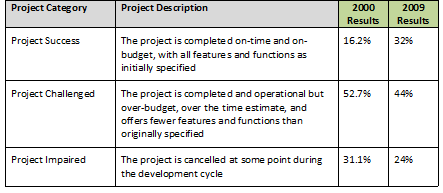
Note – In 2000 in the US, the spend on IT application development is approximately $250 billion and represents some 175000 projects. The average cost of a development project for a large company is $2,322,000; for a medium company, it is $1,331,000; and for a a small company, it is $434,000
Read more...
Some years back I was asked to take over a supposedly well run Programme of Work delivering a Siebel solution across Europe and South America. After a suitable handover period I finally got my chance to attend a Programme Board meeting. During the meeting I became concerned at the low number of escalated risks and issues (numbering in single digits) with none of them identifying who owned them, or what the progress was in resolving them. The escalated risk and issues looked more like a “to-do” list with very little tracking. It was clear to me that the risk and issue management was failing especially when many of the reported risks and issues seemed very trivial for a programme with upwards of 1500 staff. Because poor risk and issue management is detailed in most project /programme surveys as a key reason for failure I new I had to get to the bottom of this issue before I took over from the out-going Programme Manager.
Read more...


 Del.icio.us
 Digg this






 All contents copyright © 2006, Orbital Media Network. All rights reserved.